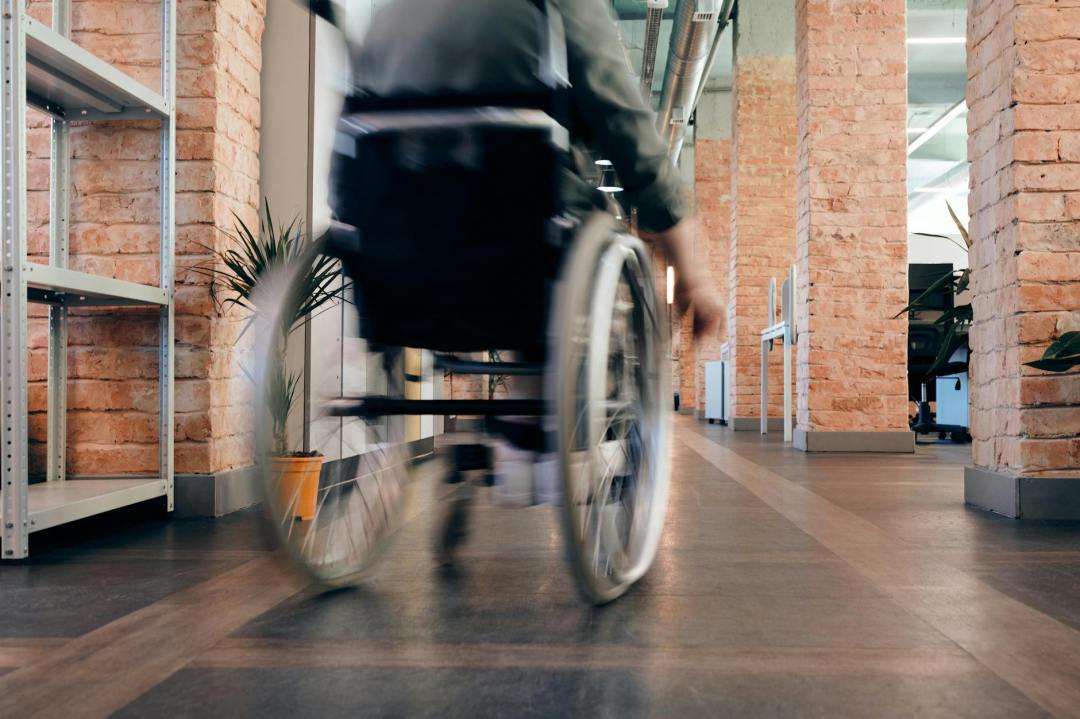
Published on December 3, 2023 International Day of Persons with Disabilities
On International Day Of Persons With Disabilities, TOI Takes A Hard Look At How Far The Accessible India Campaign Has Come Since Its 2015 Launch. While Public Infrastructure Has Become Inclusive To Some Extent, It’s Clearly Not Enough
For common people, their city can only be good as the convenience its public spaces offer. Add the needs of people with disabilities into the mix and that’s when a clearer picture emerges on how inclusive the city is for this segment of society. And if there is indeed inclusive infrastructure in place, does it really meet universal norms or is it mere tokenism?
This International Day of Persons with Disabilities, Government of India’s ambitious Accessible India or Sugamya Bharat campaign completes eight years. Launched in 2015, the campaign aimed at making both physical and digital spaces accessible to people with disabilities (PwDs). Its implementation, according to activists and PwDs in Ahmedabad, has remained a mixed bag.
Samir Kakkad, founder president of Akhil Hindustani Viklang Sangathan, says that some efforts in this direction have been made through accessibility audits at places such as GSRTC depots by the disability com missioner office. “Some changes have also been made after the audit. But overall, compliance with universal accessibility norms has remained poor,” he said, adding that opportunities for PwDs are closely linked to mobility.
While there is no public data available on how accessible buildings in Gujarat’s cities are, that from a mobile app developed by India and US-based Voice of Specially Abled Persons (VoSAP) has ratings on a scale of 1 to 5 for buildings in Ahmedabad, Surat, Vadodara and Rajkot. Of the 12,666 buildings surveyed on the app, only 7% were voted as having ‘5 star’ facilities for PwDs. On average, 62% or six in every 10 buildings were in the ‘inaccessible’ category.
“When we talk about concepts such as universal accessibility, not only PwDs, but pregnant women, the elderly and people with fractures also benefit if the buildings and spaces are accessible. It goes beyond constructing a ramps,” said Bhushan Punani, executive secretary of the Blind People’s Association (BPA). “We must laud the efforts in sectors such as railways, BRTS and metro, but the onus is on everyone to think in terms of all potential users.”
Prakash Mankodi, managing director of Andh Mahila Vikas Gruh in Rajkot said that the removal of barriers may take some time. Gopal Chudasama, a developer from Rajkot said, “The new general development control regulations (GDCR) make disability-friendly infrastructure mandatory, but there’s no mandate to convert all buildings into disability-friendly structures like there is for fire safety.”
(With inputs from Nimesh Khakhariya in Rajkot)
BASICS OF BARRIER-FREE ACCESSIBILITY
● A public facility should have ramp gradient of 1:12 or 1:20, which means that for every inch of height change, 12 to 20 inches should be added to the ramp run
● Ramps must have double handrails on both sides at heights of 70cm and 90cm for continuous grip or hold
● Non-slip tiles and adequate landing space for wheelchair
● Elevators with numbers in Braille and flooring at the same level as lift’s cabin
● Room doors should not open to pathways and a clear space of 900mm should be provided
● Washrooms with low toilet commodes, handles and slanted mirror
● Low-floor buses and a hydraulic wheelchair lift platform
Biggest Hurdles: Access to Public Toilets, Lack of Ramps
Nita Panchal, a wheelchair user and a disability rights activist from Ahmedabad, says she knows of people who go without water for extended hours if they are attending an event or need to travel. “The reason is the lack of toilets for people with disabilities. If there are no handrails, the person has to crawl on the dirty floor to reach the toilet seat. It is embarrassing and offensive. We all know the condition of public toilets for even the able-bodied people. Clean toilets, therefore, are a prerequisite.” Panchal added that another issue wheelchair users and blind people face is lack of appropriate ramps. “Many buildings have ramps just to mark the building ‘accessible.’ But they are often very steep or without adequate gradient. Some don’t have handrails.”
Vocal advocacy required
Pranav Desai, founder of the Voice of Specially Abled People (VoSAP) and vice president in a US-based tech company, launched the VoSAP app in 2015. Desai, who was among the forces behind the Accessible India campaign, said there have been both hits and misses in the past eight years. “The overall awareness about and standardization of accessible environments have grown since 2015. The issue is implementation. The app is a citizen-centric tool to respectfully point out the issues, thereby nudging the government or the implementing agencies to act,” he said. “The app provides a person a platform to mark a spot, take pictures and provide a description. If conventional ways do not work, only then one must resort to social media.”


 Parth Shastri Archive