
Published on October 18, 2023
AHMEDABAD: Just like Bryan Adams’ ‘Summer of 69’ takes you on a trip down memory lane, the autumn of ’69 brings waves of electronic music nostalgia to the quaint red-brick campus of the country’s first design school situated in Ahmedabad.
That’s when some of the first tracks of electronic music were composed in India using an avant-garde ‘Moog Synthesizer’ on the NID campus here during the after-hours. The magical discovery of these rather vintage compositions came to light recently as London-based sound curator and artist, Paul Purgas put forth his research, ‘The NID Tapes’.
The tapes were hidden from the public eye for decades until discovered and meticulously compiled by Purgas, who was determined to take them to the people.

NID tapes soundtrack of post-Independence India
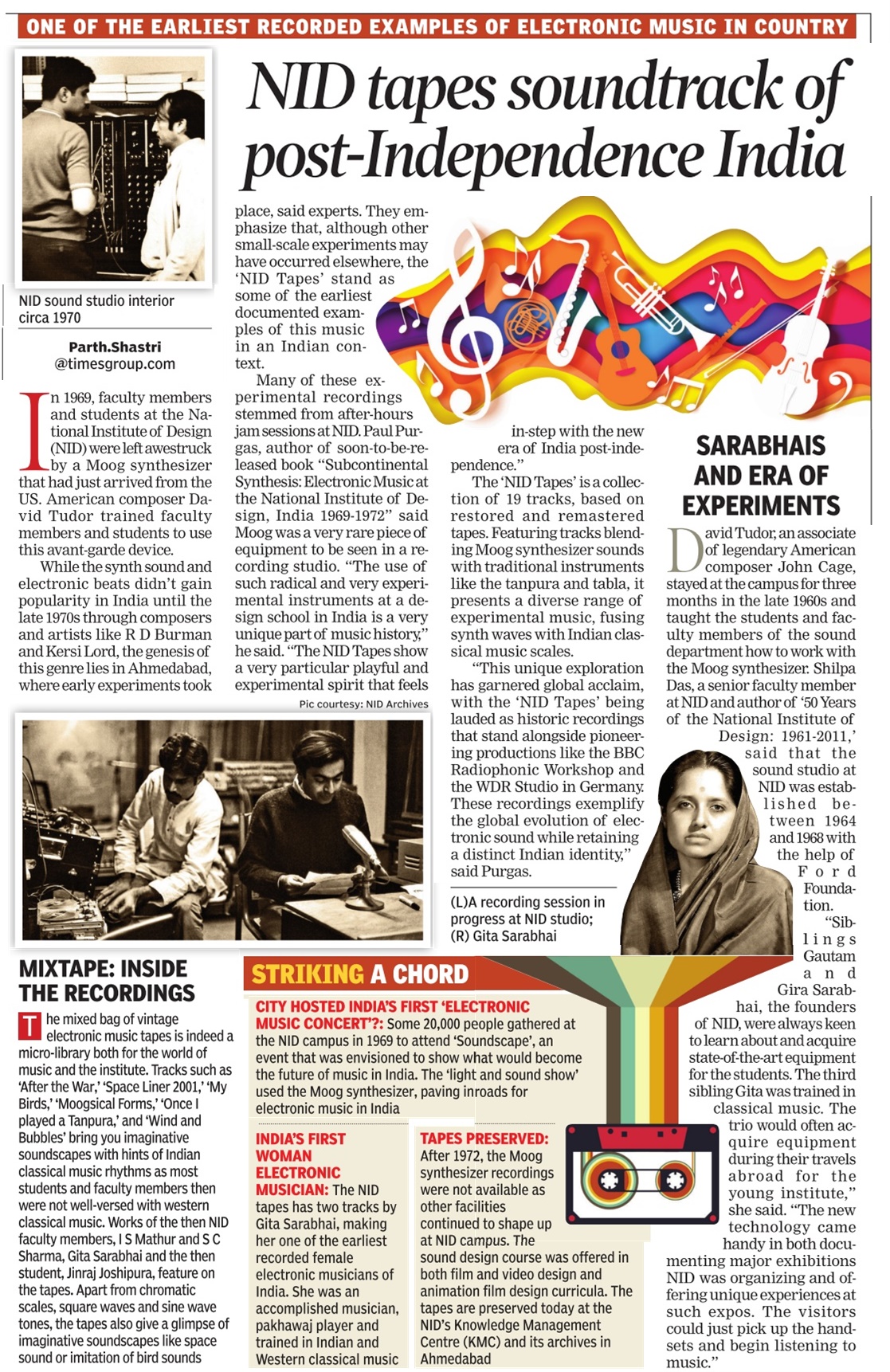
In 1969, faculty members and students at the National Institute of Design (NID) were left awestruck by a Moog synthesizer that had just arrived from the US. American composer David Tudor trained faculty members and students to use this avant-garde device.
While the synth sound and electronic beats didn’t gain popularity in India until the late 1970s through composers and artists like R D Burman and Kersi Lord, the genesis of this genre lies in Ahmedabad, where early experiments took place, said experts. They emphasize that, although other small-scale experiments may have occurred elsewhere, the ‘NID Tapes’ stand as some of the earliest documented examples of this music in an Indian context.
Many of these experimental recordings stemmed from after-hours jam sessions at NID. Paul Purgas, author of soon-to-be-released book “Subcontinental Synthesis: Electronic Music at the National Institute of Design, India 1969-1972” said Moog was a very rare piece of equipment to be seen in a recording studio. “The use of such radical and very experimental instruments at a design school in India is a very unique part of music history,” he said. “The NID Tapes show a very particular playful and experimental spirit that feels in-step with the new era of India post-independence.”
The ‘NID Tapes’ is a collection of 19 tracks, based on restored and remastered tapes. Featuring tracks blending Moog synthesizer sounds with traditional instruments like the tanpura and tabla, it presents a diverse range of experimental music, fusing synth waves with Indian classical music scales.
“This unique exploration has garnered global acclaim, with the ‘NID Tapes’ being lauded as historic recordings that stand alongside pioneering productions like the BBC Radiophonic Workshop and the WDR Studio in Germany. These recordings exemplify the global evolution of electronic sound while retaining a distinct Indian identity,” said Purgas.
While the synth sound and electronic beats didn’t gain popularity in India until the late 1970s through composers and artists like R D Burman and Kersi Lord, the genesis of this genre lies in Ahmedabad, where early experiments took place, said experts. They emphasize that, although other small-scale experiments may have occurred elsewhere, the ‘NID Tapes’ stand as some of the earliest documented examples of this music in an Indian context.
Many of these experimental recordings stemmed from after-hours jam sessions at NID. Paul Purgas, author of soon-to-be-released book “Subcontinental Synthesis: Electronic Music at the National Institute of Design, India 1969-1972” said Moog was a very rare piece of equipment to be seen in a recording studio. “The use of such radical and very experimental instruments at a design school in India is a very unique part of music history,” he said. “The NID Tapes show a very particular playful and experimental spirit that feels in-step with the new era of India post-independence.”
The ‘NID Tapes’ is a collection of 19 tracks, based on restored and remastered tapes. Featuring tracks blending Moog synthesizer sounds with traditional instruments like the tanpura and tabla, it presents a diverse range of experimental music, fusing synth waves with Indian classical music scales.
“This unique exploration has garnered global acclaim, with the ‘NID Tapes’ being lauded as historic recordings that stand alongside pioneering productions like the BBC Radiophonic Workshop and the WDR Studio in Germany. These recordings exemplify the global evolution of electronic sound while retaining a distinct Indian identity,” said Purgas.

 Parth Shastri Archive