
Published on October 2, 2023
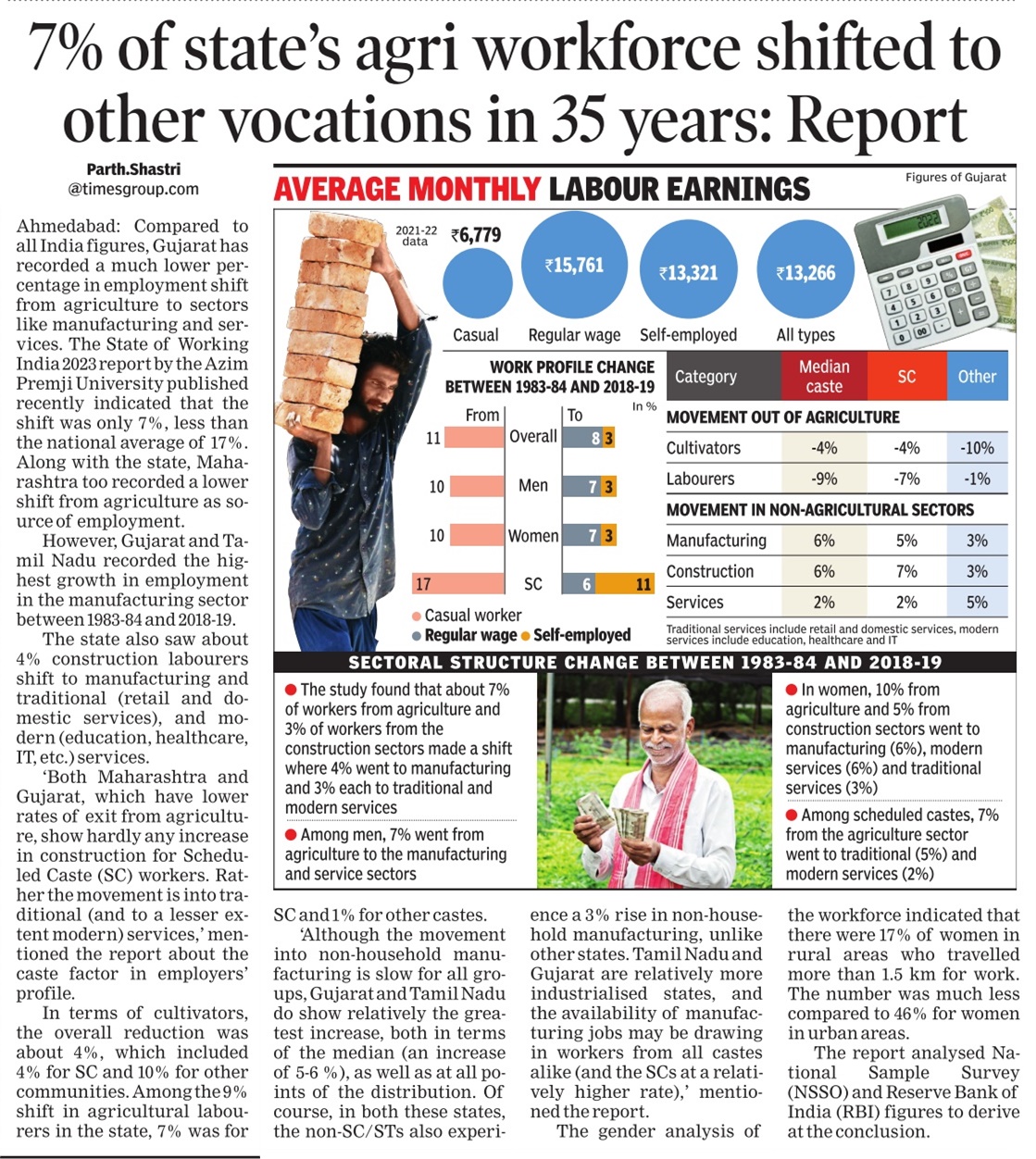
Ahmedabad: Compared to all India figures, Gujarat has recorded a much lower percentage in employment shift from agriculture to sectors like manufacturing and services. The State of Working India 2023 report by the Azim Premji University published recently indicated that the shift was only 7%, less than the national average of 17%. Along with the state, Maharashtra too recorded a lower shift from agriculture as source of employment.
However, Gujarat and Tamil Nadu recorded the highest growth in employment in the manufacturing sector between 1983-84 and 2018-19.
The state also saw about 4% construction labourers shift to manufacturing and traditional (retail and domestic services), and modern (education, healthcare, IT, etc.) services.
‘Both Maharashtra and Gujarat, which have lower rates of exit from agriculture, show hardly any increase in construction for Scheduled Caste (SC) workers. Rather the movement is into traditional (and to a lesser extent modern) services,’ mentioned the report about the caste factor in employers’ profile.
In terms of cultivators, the overall reduction was about 4%, which included 4% for SC and 10% for other communities. Among the 9% shift in agricultural labourers in the state, 7% was for SC and 1% for other castes.
‘Although the movement into non-household manufacturing is slow for all groups, Gujarat and Tamil Nadu do show relatively the greatest increase, both in terms of the median (an increase of 5-6 %), as well as at all points of the distribution. Of course, in both these states, the non-SC/STs also experience a 3% rise in non-household manufacturing, unlike other states. Tamil Nadu and Gujarat are relatively more industrialised states, and the availability of manufacturing jobs may be drawing in workers from all castes alike (and the SCs at a relatively higher rate),’ mentioned the report.
The gender analysis of the workforce indicated that there were 17% of women in rural areas who travelled more than 1.5 km for work. The number was much less compared to 46% for women in urban areas.
The report analysed National Sample Survey (NSSO) and Reserve Bank of India (RBI) figures to derive at the conclusion.

 Parth Shastri Archive