Published on June 30, 2023
AHMEDABAD: Earlier this week, Gujarat was jolted by shocking deaths of two students – a 17-year-old girl in Navsari and a 28-year-old youth in Rajkot – who fatally collapsed at their respective school and college reportedly due to heart failure. These were not solitary instances.
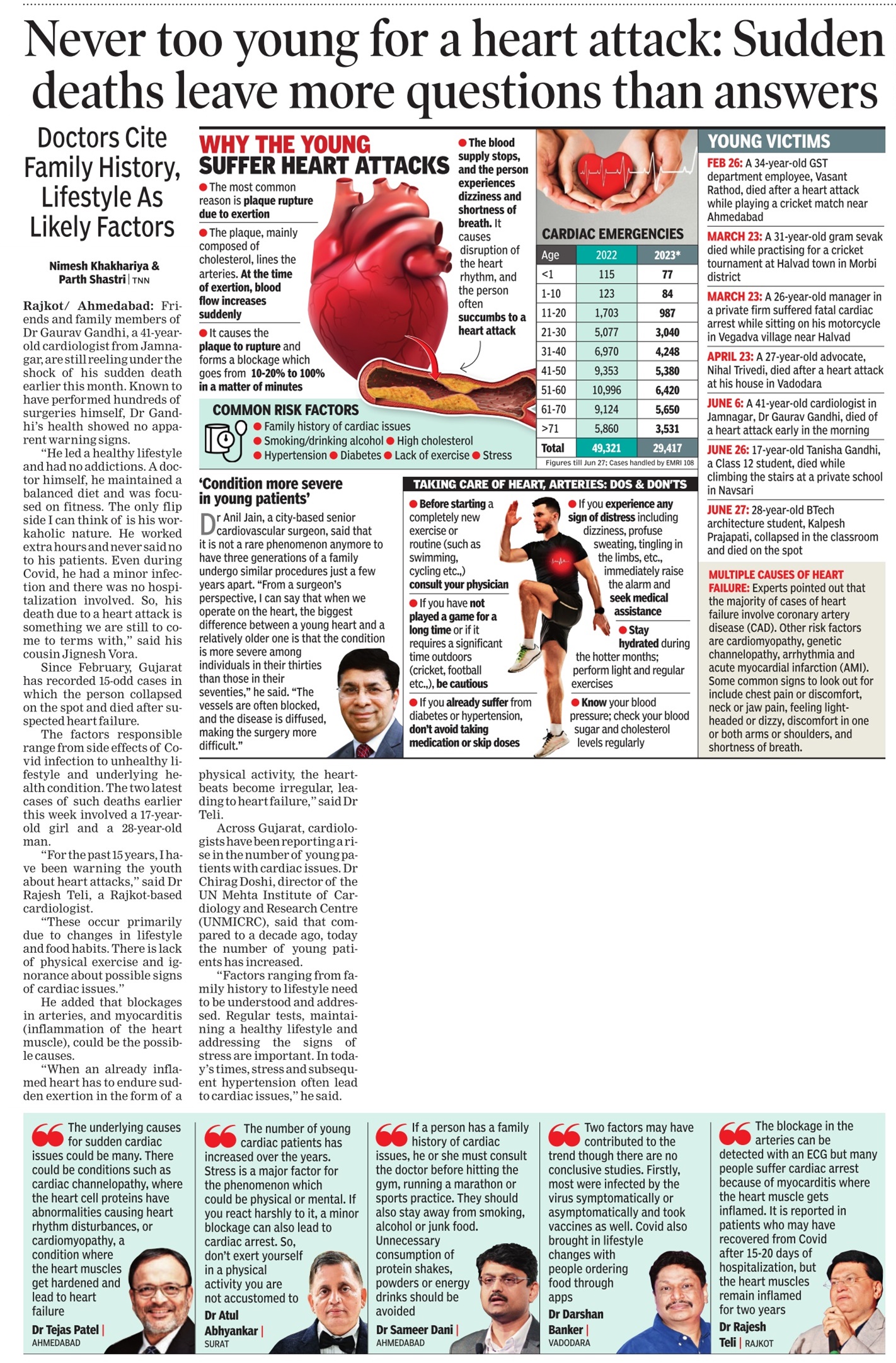
As per data of EMRI 108 emergency services, 6,780 cardiac emergencies were recorded in youth under 30 years of age. Alarmingly, this year till June 26, the number has already crossed 4,027 or 60% of last year. At this rate, heart crisis in young is projected to reach 8,258 at the end of year or clocking a 22% year-on-year rise. In the overall tally, the age group 10-30 years accounts for 14% of calls.
The sudden deaths have worried citizens and has even prompted the Centre to form a panel under ICMR to probe whether there is a connection between sudden heart failure and Covid.
At Apollo Hospital, a 21-year old youth was one of the youngest in recent past to undergo an angioplasty. The youth reported severe chest pain and was brought to hospital in time to find a block. The seemingly healthy youth had plaque lining his arteries. A sudden rupture is believed to have led to the block.
“As observed in several popular videos, sudden exertion such as running, gymming or physical activity can lead to such heart conditions. But when we talk about cardiac issues at a young age, we generally see relatively older heart attributes in younger patients,” said Dr Samir Dani, a interventional cardiologist. “Combined factors including family history and lifestyle make the young and restless vulnerable to early onset of heart conditions.”
Experts also advocate investigation in these cases to get insight in heart condition. Dr Tejas Patel, senior interventional cardiologist, said there could be underlying abnormalities such as cardiac channelopathy or cardiomyopathy, a condition where the heart muscles get hardened and lead to heart failure.
Friends and family members of Dr Gaurav Gandhi, a 41-year-old cardiologist from Jamnagar, are still reeling under the shock of his sudden death earlier this month. Known to have performed hundreds of surgeries himself, Dr Gandhi’s health showed no apparent warning signs.
“He led a healthy lifestyle and had no addictions. A doctor himself, he maintained a balanced diet and was focused on fitness. The only flip side I can think of is his workaholic nature. He worked extra hours and never said no to his patients. Even during Covid, he had a minor infection and there was no hospitalization involved. So, his death due to a heart attack is something we are still to come to terms with,” said his cousin Jignesh Vora.
Since February, Gujarat has recorded 15-odd cases in which the person collapsed on the spot and died after suspected heart failure.
The factors responsible range from side effects of Covid infection to unhealthy lifestyle and underlying health condition. The two latest cases of such deaths earlier this week involved a 17-year-old girl and a 28-year-old man.
“For the past 15 years, I have been warning the youth about heart attacks,” said Dr Rajesh Teli, a Rajkot-based cardiologist.
“These occur primarily due to changes in lifestyle and food habits. There is lack of physical exercise and ignorance about possible signs of cardiac issues.”
He added that blockages in arteries, and myocarditis (inflammation of the heart muscle), could be the possible causes.
“When an already inflamed heart has to endure sudden exertion in the form of a physical activity, the heartbeats become irregular, leading to heart failure,” said Dr Teli.
Across Gujarat, cardiologists have been reporting a rise in the number of young patients with cardiac issues. Dr Chirag Doshi, director of the UN Mehta Institute of Cardiology and Research Centre (UNMICRC), said that compared to a decade ago, today the number of young patients has increased.
“Factors ranging from family history to lifestyle need to be understood and addressed. Regular tests, maintaining a healthy lifestyle and addressing the signs of stress are important. In today’s times, stress and subsequent hypertension often lead to cardiac issues,” he said.
(With inputs from Nimesh Khakariya)



 Parth Shastri Archive